Skip to content

Lifty Fifty Training Library

The science behind strength.

Check your squat setup, understand “2 RIR” or see how a training max sets the weight on the bar. The Lifty Fifty Training Library explains the instructions you meet in training and the science behind them.

Browse the library contents

The library’s foundations

Built from established training knowledge.

The Lifty Fifty Training Library brings strength and conditioning references, exercise science and anatomy into one place. It connects that material to movement instructions, programme examples and the training record.

Strength and conditioning

The NSCA’s Essentials of Strength Training and Conditioning and ACSM’s Resources for the Personal Trainer appear in the underlying movement and programme-design references.

Research behind the methods

Published resistance-training research helps explain specific methods. Zourdos and colleagues’ RPE and repetitions-in-reserve scale study informs the effort reference.

Anatomy behind each movement

Muscle actions, joint mechanics and stabilising roles provide context for the movements described in the library.

Lifty Fifty adapts and connects reference material for practical training. Named sources do not endorse Lifty Fifty.

Read the training principles
Your training Programmes Movements Training principles Anatomy & sources
From reference material to the next set.

An encyclopaedic training reference

Find the explanation you need.

Look up an unfamiliar instruction, compare two exercises or check how a progress metric is calculated. Browse the six subjects below.

960+Movement references
153Muscle references
34Joint references
19Training principles

Movements

Check how to set up and perform a lift, then explore the anatomy and programming behind it.

Reference detail
  • Setup, execution phases, breathing, coaching cues and common mistakes.
  • Movement patterns, equipment, muscle roles and joint involvement.
  • Intensity formats, reference tempo and related movement alternatives.
Explore every movement field

Muscles & joints

See which muscles and joints a movement uses and what each one does.

Reference detail
  • Muscle origins, insertions, actions and nerve supply.
  • Primary, secondary and stabilising roles within a movement.
  • Joint surfaces, ligaments, supported movements and training notes.
Browse all muscles and joints

Training principles

Make sense of effort targets, training maxes and the principles behind your programme.

Reference detail
  • RPE and RIR: effort, proximity to failure and how to interpret them.
  • 1RM and training max: different references for working load.
  • Progressive overload, periodisation, deloads and adaptation.
Browse all training principles

Programme design

Understand how exercise choice, sets, rest and progression fit together in a plan.

Reference detail
  • Exercise selection and order, session structure and split routines.
  • Working sets, load, repetitions, rest periods and training frequency.
  • Load and volume progression, training phases and periodisation models.
See a nine-week programme

Metric definitions

Find out what a training metric measures, how it is calculated and how to read it.

Reference detail
  • Definitions, units, required inputs and calculation methods.
  • Examples such as Average Working Intensity and Working Sets Per Muscle.
  • Interpretation, missing-data limits and useful comparisons.
Browse every pillar and metric

Tools & references

Use practical references to plan a load or interpret a recorded set.

Reference detail
  • Plate Pilot: plate combinations and changes to an already-loaded bar.
  • Rep-max estimates alongside the loads and repetitions behind them.
  • RPE and RIR references for planned and recorded effort.
Explore the training tools

Counts describe distinct references in the underlying library. Movement names and aliases aid search; they are not counted as separate exercises.

The library in use

Understand the detail in a working set.

Use this squat example to check technique, identify the muscles involved, interpret an effort target and understand relative load. Each tab shows the relevant reference material.

Worked reference exampleIllustrative set

The movement

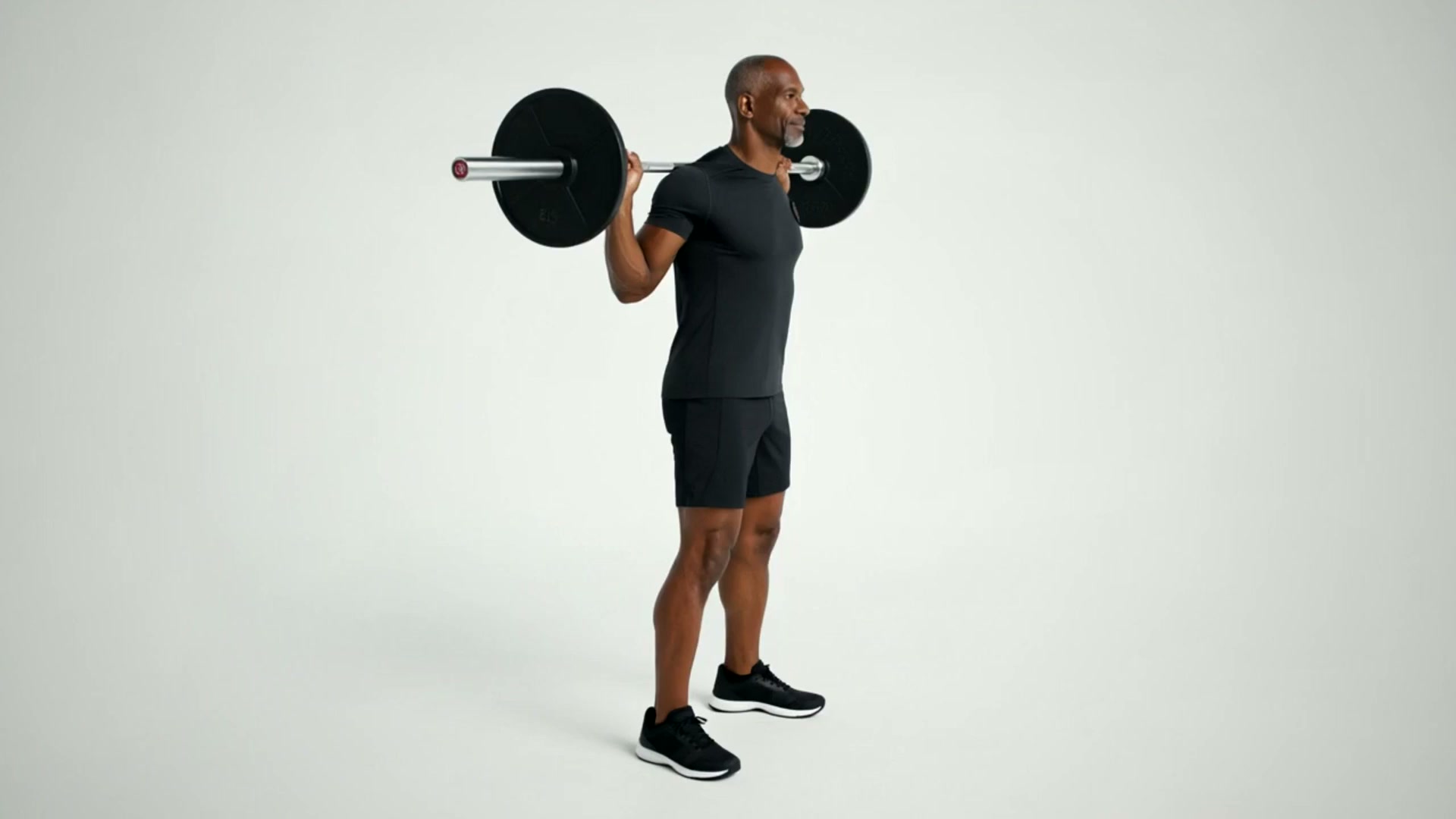
Back Squat (Low Bar)

Load
80 kg
Repetitions
5
Recorded effort
2 RIR

Movement reference

Back Squat (Low Bar)

Before this set, check the bar position, rack setup and execution phases in the low-bar squat reference.

Pattern
Squat · Compound · Bilateral
Equipment
Barbell and rack
Primary muscle groups
Glutes · Quadriceps

How the movement is performed

Follow the descent, bottom position and ascent separately. The coaching notes explain what to watch for in each part of the lift.

Example coaching point: let your hips and shoulders rise together as you stand.

Muscle & joint reference

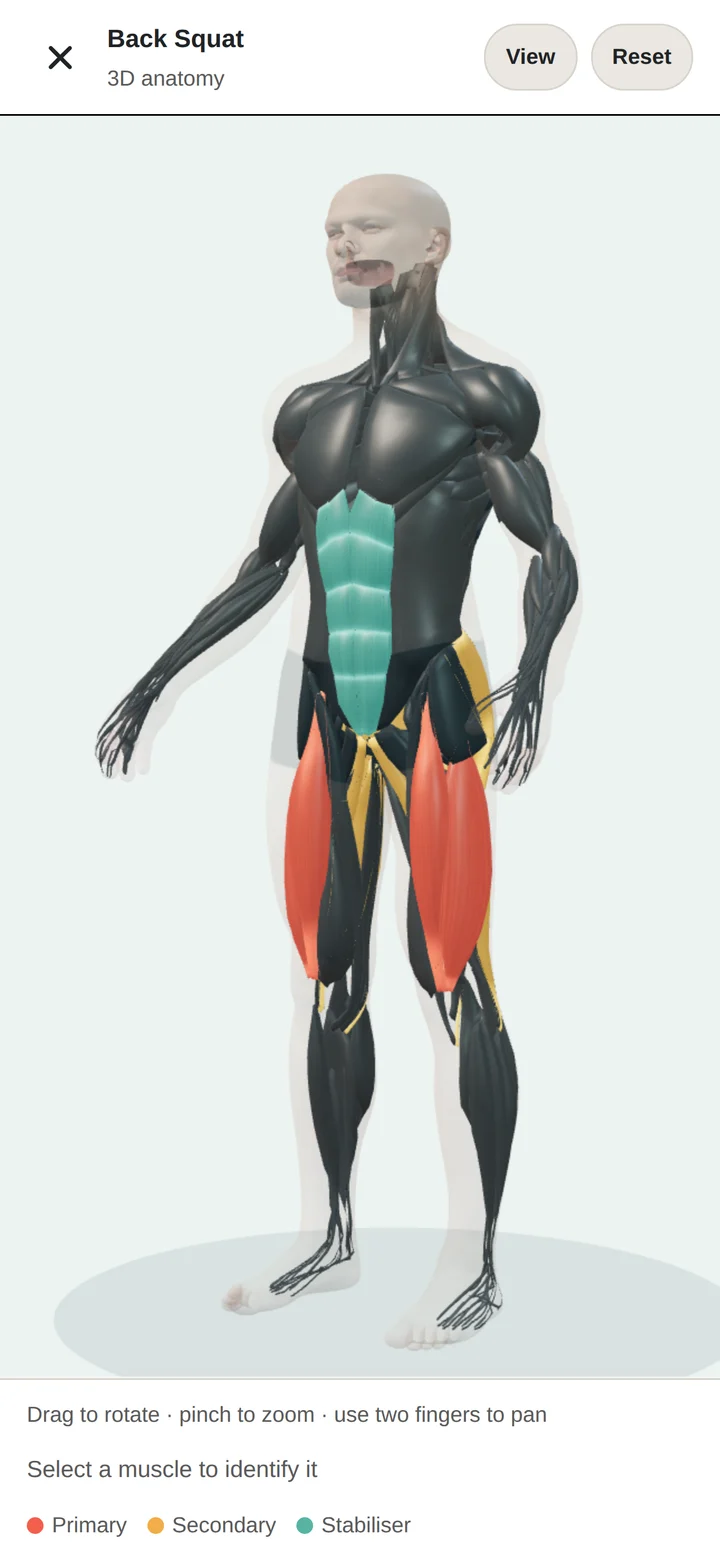
Muscle roles and joint involvement in the squat

The movement reference identifies the muscles and joints involved in this squat. The load and rep count alone cannot provide that context.

Primary groups
Glutes · Quadriceps
Secondary groups
Hamstrings · Hip adductors
Stabilising groups
Spinal extensors · Abdominals · Upper back

Muscles and joints connected to the movement

Read the individual muscle roles, including gluteus maximus and the quadriceps. Follow the hip, knee and ankle references alongside the execution notes.

Muscle roles describe the movement reference. They do not measure your personal muscle activation or growth.

Training principle / RIR

Interpret 2 RIR

For this five-repetition set, 2 RIR means you estimate that about two further repetitions were possible. Reps in Reserve describes proximity to failure, not the percentage of 1RM lifted.

0 RIR
No further repetition judged possible
Example set
5 completed reps · About 2 further reps possible
What it records
Your estimate of effort for that set

Interpreting the instruction

A target of 2 RIR asks you to finish with roughly two repetitions still available. Your recorded RIR captures how the set actually felt. The planned and recorded values can differ.

RIR is an estimate, and its accuracy varies. It adds context alongside the load and repetitions you recorded.

Metric reference / Strength

Interpret 80% of 1RM

The example set uses 80 kg. Against an illustrative 100 kg 1RM for this same movement, its relative load is 80% of 1RM.

Working load
80 kg
Example 1RM reference
100 kg · Same movement
Relative load
80 ÷ 100 × 100 = 80% of 1RM

From one set to Average Working Intensity

This is the percentage for one working set. Average Working Intensity averages the resolved percentages across qualifying sets. Read it alongside repetitions, set count and programme intent.

Missing or incompatible 1RM data limits coverage. Averages can also hide a mix of lighter and heavier work.

Reference excerpts for one illustrative set. Use the links to explore the full movement reference, session example and pillar metrics.

Movement Intelligence

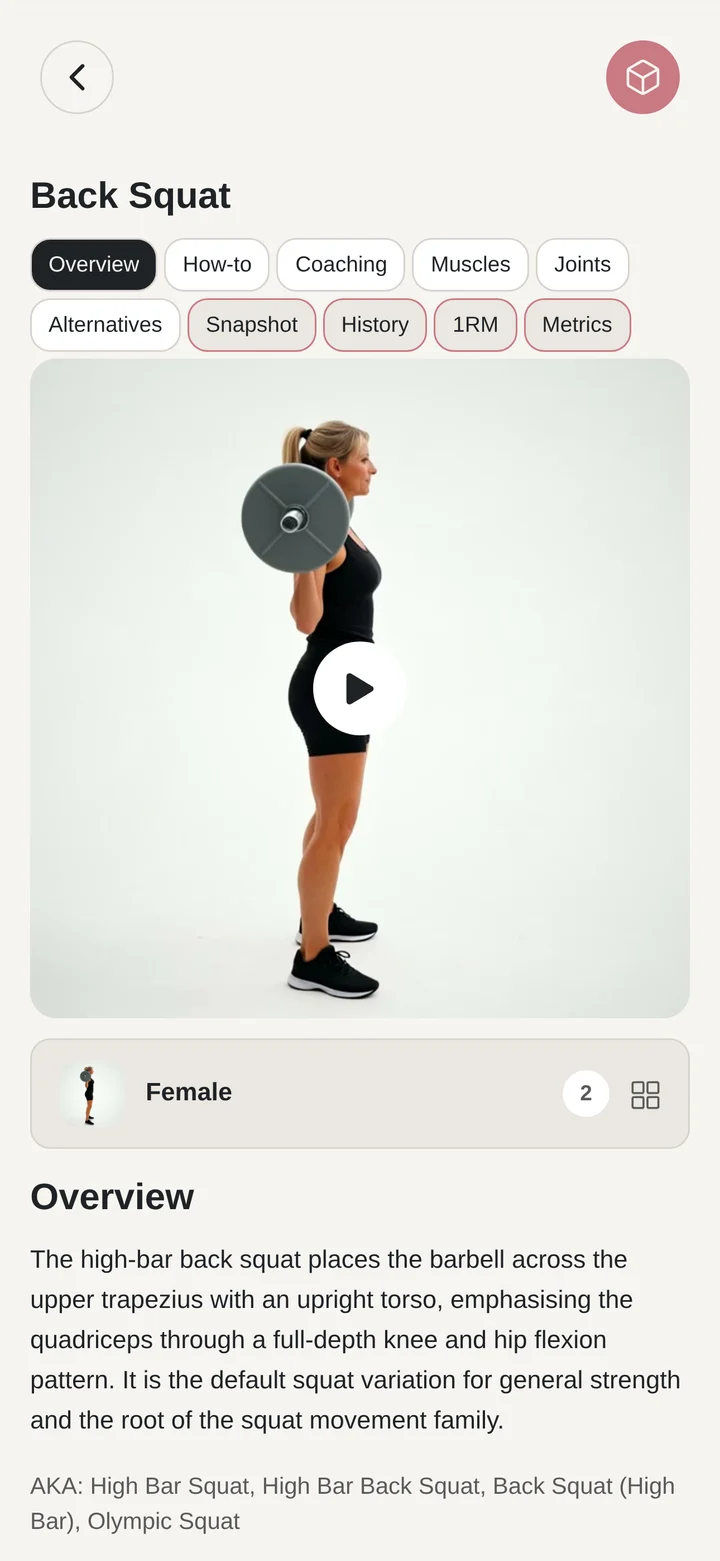
Movement reference during the session.

Open a movement during a session to access its demonstration, coaching guidance and anatomy. The same reference remains connected to recorded sets, alternatives and programme context.

The library provides the complete subject reference. Movement Intelligence presents the relevant material within the active session.

Explore Movement Intelligence
Goblet squat reference showing movement guidance tabs
Movement guidance
Interactive anatomy view highlighting muscles involved in the back squat
Explore the anatomy